
LINK 2007 events at Codeway Expo 2025
22/05/2025
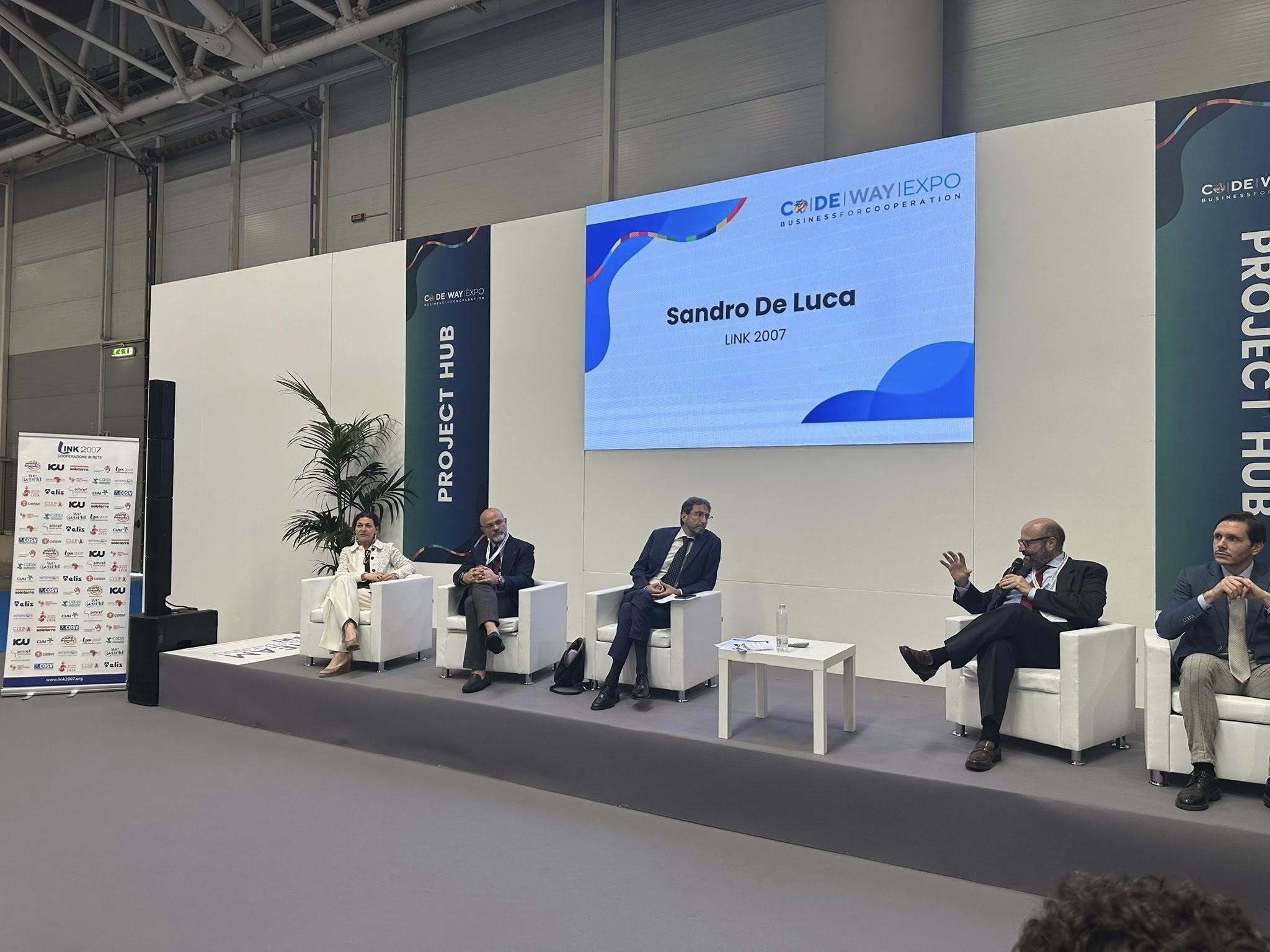
In the context of Codeway Expo 2025, LINK 2007 promoted three events – between 14 and 15 May – that offered an in-depth and articulate reflection on some of the main challenges of international cooperation, starting from the transformation of the geopolitical scenario to the need to tackle the issues of migration and debt in the most vulnerable countries with systemic and innovative approaches. The meetings, attended by representatives of Italian and African institutions, representatives of civil society, academia and the private sector, confirmed the urgency of reformulating strategies and tools to address the challenges of a rapidly and profoundly changing world.
The event “Development Cooperation: Reflections and Solutions for a Changing World”, held on 14 May, opened the cycle of meetings with a debate facilitated by Roberto Ridolfi, aimed at questioning which direction development cooperation should take today. The discussion highlighted how global dynamics – from the crisis of multilateral governance to the emergence of new hegemonies, from the disintegration of democratic systems to the consequences of climate change – call for a radical rethinking of the role of Public Development Aid and traditional partnerships.
Carlo Batori, Deputy Director General of the DGDC of the MAECI, emphasised that although resources for cooperation are decreasing globally, this should not be read as a defeat. On the contrary, the current moment can represent an opportunity to rationalise, optimise and strengthen the effectiveness of interventions, focusing on three fundamental axes: training and human capital, technological and organisational innovation, and the building of more structured partnerships.
Sandro De Luca, President of LINK 2007, emphasised the new positioning of CSOs in relation to other international cooperation actors. As the President argued, there is today an ever clearer recognition of how crucial it is to enhance the diversity of competences, experiences and capacities present in the cooperation sector and how this richness is essential to face the complex and interconnected challenges of international development.
The discussion expanded with the intervention of Francesco Corvaro, Special Envoy of the Italian Government for Climate Change, who reiterated the need to integrate the environmental dimension in development cooperation in a systemic way. The contributions of Confindustria, represented by Pasquale Cerbone, and ENI, with Barbara Mineo, highlighted the value of private sector involvement as a driver of sustainable, technological and inclusive development.
A second seminar was held in the afternoon of the same day, this time devoted to the relationship between vocational training and migration policies, starting from the project A Brighter Future. Moderated by Sandro De Luca, the meeting offered a lively and concrete discussion on how to build regular, safe migration paths and above all based on real opportunities for growth and development in countries of origin and destination.
The key idea that emerged is that migration cannot be stopped, but must be governed: and to do so, it is necessary to invest in the training of young people, particularly on the African continent, where population growth makes a structured investment in human capital even more urgent. Stefano Bianchi (DGIT) reiterated the need for integration between development and mobility policies, while Laurence Hart (IOM) stressed the importance of training chains linked to labour markets, as the key to making migration a choice and not an escape. Inspiring interventions also came from Dina Rosa Agyemang (Aurora Foundation) and Cleophas Adrien Dioma (Italy Africa Business Week), who brought attention to the transformative potential of training for young Africans, linking it to a positive and strategic narrative of migration. Stefano Gatti, Director General of the DGDC, closed by reiterating that Italian cooperation must take the lead in promoting circular and qualified mobility models, integrated in local development plans.
The series of events concluded on the morning of 15 May with a seminar dedicated to one of the most critical issues for Africa’s future: public debt. The focus of the meeting was the presentation of the RELEASE proposal — elaborated by LINK 2007 as a model for an equitable, sustainable and timely debt reconversion. This meeting was also moderated by Roberto Ridolfi, who illustrated the case of Zambia as a pilot country for the application of the initiative. Zambia’s Ambassador Patricia Chisanga Kondolo welcomed the proposal, expressing her country’s interest in collaborating.
The seminar highlighted how debt is becoming unsustainable for many African countries, stifling the possibility of investment in crucial development sectors. RELEASE, in this scenario, is proposed as a tool to free up resources for education, health, ecological transition and the reduction of inequalities. Leonardo Becchetti (University of Rome Tor Vergata), who spoke online, insisted on the urgency of treating debt not only as an accounting problem but as a question of global justice. Ugo Melchionda (Last20), added that debt sustainability is closely linked to the ability of countries to create inclusive development and retain their talent.
The Jubilee 2025, represents a great opportunity to relaunch the importance of a structural reform of the debt system, restoring economic sovereignty and the possibility of a future to the most fragile countries.
With these three events, LINK 2007 has confirmed its role as a promoter of critical, strategic and action-oriented thinking in the field of international cooperation. An ambitious agenda, which looks to the future with the awareness that only through renewed tools, multi-level partnerships and the protagonism of local communities will it be possible to face the great global challenges and build a fairer, more equitable and sustainable world.
To review the event ‘Development Cooperation: reflections and solutions for a changing world’ CLICK HERE